
12 metal-gear servos
Articulated legs and head movement support walking, standing, sitting, turning, and expressive poses.
MaelstromLabsDX is preparing a SunFounder PiDog V2 build—an approachable Raspberry Pi robotics platform for exploring motion, sensing, vision, interaction, and practical AI behaviors.
PiDog combines an aluminum-alloy frame with articulated legs, onboard sensing, visual input, expressive lighting, and audio. Our build will use that foundation to study coordinated movement, obstacle awareness, responsive behaviors, and increasingly autonomous interaction.
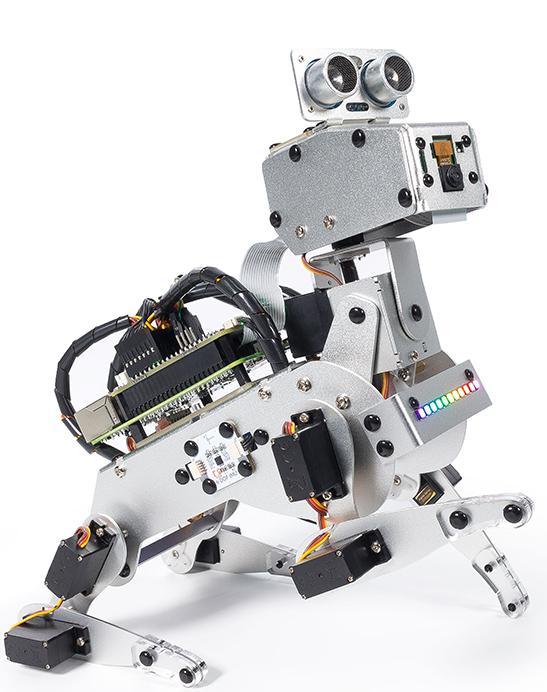
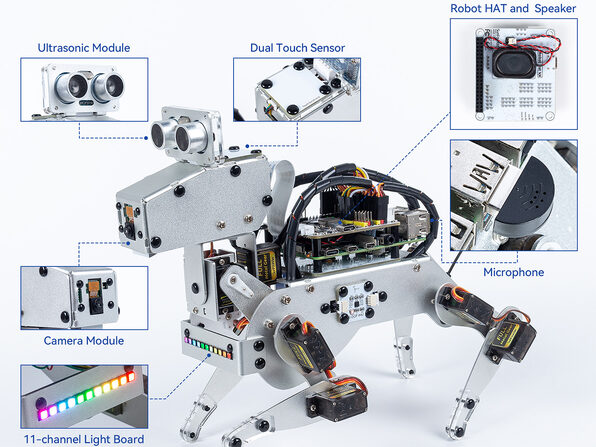
The V2 platform supports Raspberry Pi 3, 4, 5, and Zero 2 W. Its collection of actuators and sensors makes it suitable for both structured tutorials and original robotics experiments.
Articulated legs and head movement support walking, standing, sitting, turning, and expressive poses.
The camera creates a foundation for color recognition, face detection, visual tracking, and future computer-vision work.
Ultrasonic ranging and a 6-axis IMU support obstacle detection, posture awareness, and more stable movement.
Touch sensors and directional sound sensing provide inputs for responsive, pet-like behaviors.
An 11-channel light board and speaker allow the robot to communicate status, reactions, and personality.
The documented software path supports calibration, scripted actions, sensing projects, and AI-assisted interaction.
We will treat the build as a measured development program: establish a dependable hardware baseline first, then add behaviors in small, testable steps.
Inventory the kit, assemble the frame and articulated legs, route wiring, and verify every connection.
Zero and calibrate the servos before validating basic poses, gait stability, and safe movement limits.
Test the camera, ultrasonic module, touch inputs, sound direction sensor, IMU, lights, and speaker individually.
Combine movement and perception into obstacle response, tracking, interaction, and experimental AI routines.